Flipkart seller guide
Flipkart Reverse Shipping Fee: When a Return Costs More Than the Product
Quick answerWhen a customer returns a Flipkart order, the sale and the refund cancel out in the settlement report, but the Reverse Shipping Fee and 18% GST on it stay with you. In one month of our own settlements, 53 customer returns carried a fee between ₹110 and ₹230, most often ₹175 (National zone) or ₹139 (Zonal), which is ₹206.50 or ₹164.02 with GST. Most of the returned products sold for ₹35 to ₹75. The 117 courier returns (Logistics Return, RTO) in the same file had no reverse shipping fee.
On this page · 6 sections
Where the fee shows in the settlement report
Download the settlement report from Flipkart Seller Hub (Payments, then Settlements) and open the Orders sheet. A customer return adds a row with the same Order item ID as the sale. One item can have several rows like this, so always read them together. On the return row:
- Refund (Rs.) is minus the sale amount, so the sale and the refund cancel out.
- Reverse Shipping Fee (Rs.) is the charge for bringing the parcel back, for example −₹139.
- GST on MP Fees (Rs.) is 18% of that fee: −₹25.02 on ₹139.
- TCS and TDS taken on the sale are given back, so they also net to zero.
- Return Type says Customer Return.
| A ₹66 product returned by the customer | Amount |
|---|---|
| Sale | ₹66.00 |
| Refund to the customer | −₹66.00 |
| Reverse Shipping Fee | −₹139.00 |
| 18% GST on the fee | −₹25.02 |
| What this order item took from your payout | −₹164.02 |
How much the fee was in our files
These are the 53 customer returns in one month of our settlements. Each row also shows the Shipping Zone, and the zone lines up with the fee: National returns cost more than Zonal ones.
- The same row carries the parcel details Flipkart recorded: Dead Weight, Length*Breadth*Height, Volumetric Weight, Chargeable Weight Source and Chargeable Wt. Slab. Compare them with your packed parcel when a fee looks high.
- Flipkart's current rate card is in Seller Hub, and it changes. Use your own report and the rate card for your numbers, not the table above.
| Reverse Shipping Fee | With 18% GST | Shipping Zone | Returns |
|---|---|---|---|
| ₹175 | ₹206.50 | National | 26 |
| ₹139 | ₹164.02 | Zonal | 13 |
| ₹170 | ₹200.60 | National | 8 |
| ₹134 | ₹158.12 | Zonal | 2 |
| ₹110 to ₹230 | ₹129.80 to ₹271.40 | Both | 1 each, 4 in all |
Customer return or RTO: read Return Type
So in our month an RTO cost us the packing and the time, while a customer return also cost the fee. Your account terms may differ, and Flipkart can change them, so check the Reverse Shipping Fee column in your own file.
| Return Type | What happened | What our settlement rows showed |
|---|---|---|
| Customer Return | The customer received the parcel and sent it back | Sale and refund cancel out; reverse shipping fee plus 18% GST stays with you |
| Logistics Return | The parcel was not delivered and came back to you (RTO) | Sale and refund cancel out; no reverse shipping fee on any of the 117 rows |
Why one return can wipe out several sales
Most of the products our customers returned that month sold for ₹35 to ₹75. A ₹164.02 or ₹206.50 charge is more than the whole price of those products.
An illustration: a product sells for ₹56 and earns you ₹20 after making and packing cost. One Zonal customer return at ₹164.02 takes away the profit of about eight delivered orders. One National return at ₹206.50 takes about ten.
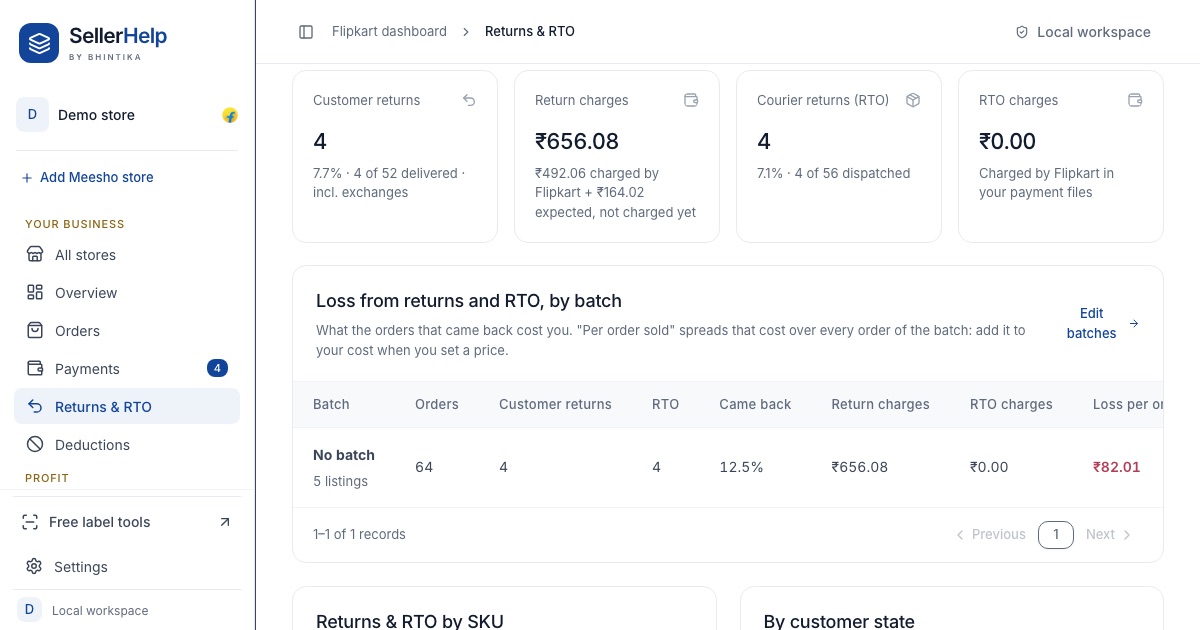
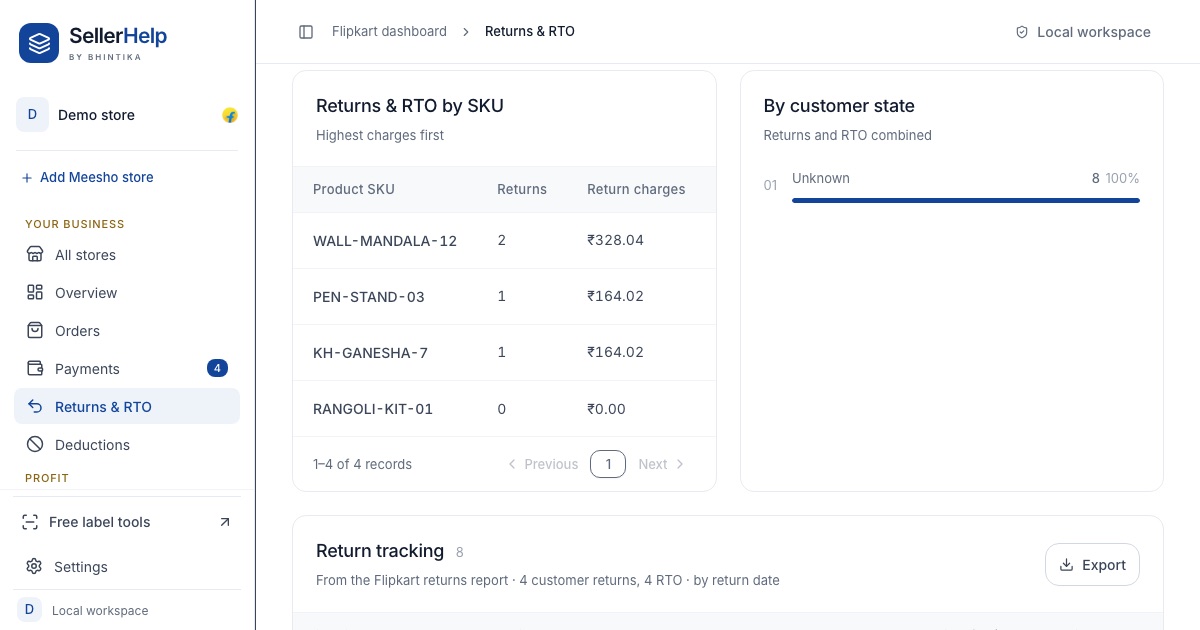
Your return rate per product decides how much this matters. The Flipkart seller dashboard splits returns and return charges by SKU, so you can see which product the fee hits hardest. Its Returns & RTO tab also spreads the loss from returns over every order sold, which is the number to add to your cost when you set a price.
What you can do about it
- Price low-cost products with the return cost in. Add the loss from returns per order sold to your cost before you set the selling price.
- Cut avoidable returns. Check that the photos, size, colour and pack quantity in the listing match what you ship, and pack so the item arrives undamaged.
- Inspect every returned parcel when it arrives. If the item is damaged, wrong or has missing parts, raise an SPF claim in Seller Hub within the time limit shown there. Approved claims are paid through the settlement report.
- Check the weight and size columns on the return row. If the recorded weight does not match your parcel, raise it with Flipkart Seller Support with photos of the packed parcel.
Frequently asked questions
Does Flipkart charge the seller for a customer return?
In our settlement files, yes. The return row has a Reverse Shipping Fee plus 18% GST on it. The sale and the refund cancel out, so the fee and GST are what the return costs you in the settlement.
Does Flipkart charge a reverse shipping fee for RTO?
None of the 117 courier returns (Return Type: Logistics Return) in our month had one; the sale and refund cancelled to zero. Check the Reverse Shipping Fee column in your own report, because terms can change.
Can I claim the GST charged on the reverse shipping fee?
The Summary sheet of the settlement report says GST on marketplace fees is eligible for input GST credit when you file GSTR. Ask your accountant how this applies to your business.
Why was my reverse shipping fee higher on some returns?
In our files, National-zone returns had higher fees than Zonal ones, and the row also shows the weight Flipkart charged on. Compare the Shipping Zone and weight columns with the rate card in Seller Hub.